



A catchy slogan can communicate your brand’s personality, values, and unique selling point in just a few memorable words. The best slogans use techniques such as wordplay, rhyme, repetition, humor, and calls to action to make a lasting impression. And when a slogan becomes an important part of your brand identity, it may also be eligible for federal trademark protection.
A great slogan can make a brand more memorable.
While a business name generally needs to be relatively short and straightforward, a slogan or tagline gives you more freedom to communicate what makes your business different. It can be funny, emotional, clever, descriptive, or inspiring.
Some of the best slogans become so closely associated with a company that consumers recognize the brand immediately—even when the company name isn’t mentioned.
If you’re looking for slogan examples and ideas for your own business, here are 25 famous and creative slogans that demonstrate what makes a tagline memorable.
What Makes a Great Slogan?
The best business slogans usually have at least one of these qualities:
- Short and memorable: Easy for customers to recall.
- Distinctive: Different enough to stand out from competitors.
- Relevant: Connected to the company, product, or customer experience.
- Clever: Uses humor, rhyme, alliteration, or wordplay.
- Emotional: Creates a feeling or association with the brand.
- Benefit-focused: Communicates why customers should choose the product or service.
- Consistent with the brand: Sounds and feels like the company behind it.
You can see many of these qualities in the famous slogan examples below.
Famous Slogan Examples from Iconic Brands
These classic advertising slogans demonstrate how a few carefully chosen words can help build a powerful brand identity.
1. Nike: Just Do It.
Few slogans are as recognizable as Nike’s Just Do It. It is short, motivational, memorable, and functions as a direct call to action.
Why it works: Three simple words capture the determination and action associated with the Nike brand.
2. De Beers: A Diamond Is Forever.
This famous slogan connects the durability of a diamond with the idea of everlasting love and commitment.
Why it works: It creates an emotional connection between the product and what the product represents.
3. American Express: Don’t Leave Home Without It.
This memorable tagline positioned the American Express card as something customers considered essential when leaving home.
Why it works: It is direct, memorable, and communicates the importance of the product.
4. Mastercard: There Are Some Things Money Can’t Buy. For Everything Else, There’s Mastercard.
This slogan connected Mastercard with experiences and memories rather than focusing exclusively on purchases.
Why it works: It uses emotion to elevate the brand beyond the basic function of a payment card.
5. HBO: It’s Not TV. It’s HBO.
HBO used this bold slogan to distinguish its programming from traditional television.
Why it works: It is short and confident while positioning HBO in a category of its own.
6. Timex: It Takes a Licking and Keeps on Ticking.
This classic slogan communicates durability while using rhyme and playful language.
Why it works: It makes a product benefit—reliability—easy to remember.
7. Bounty: The Quicker Picker Upper.
Bounty’s slogan is memorable because of its rhythm, rhyme, and repetition.
Why it works: It is fun to say while communicating what the product is designed to do.
8. State Farm: Like a Good Neighbor, State Farm Is There.
This long-running slogan connects State Farm with reliability, familiarity, and being there when customers need help.
Why it works: It communicates the company’s desired relationship with its customers.
9. GEICO: So Easy, a Caveman Can Do It.
GEICO used humor to reinforce the simplicity of its service.
Why it works: The concept is funny, distinctive, and communicates a clear benefit: ease of use.
10. Apple: Think Different.
Apple’s famous slogan reinforced the brand’s association with creativity, innovation, and challenging conventional thinking.
Why it works: It is extremely short while communicating a much larger brand philosophy.
Famous Food and Beverage Slogans
Food and beverage brands often create catchy slogans using sensory language, humor, repetition, and descriptions of the product experience.
11. Taco Bell: Think Outside the Bun.
Taco Bell put a clever spin on the familiar phrase “think outside the box.”
Why it works: The wordplay is directly connected to the product and differentiates Taco Bell from traditional burger-based fast food.
12. M&M’s: Melts in Your Mouth, Not in Your Hand.
This slogan clearly communicates a distinctive feature of the candy.
Why it works: It is memorable while also highlighting a specific product benefit.
13. Dunkin’: America Runs on Dunkin’.
This short slogan positions Dunkin’ as part of customers’ everyday routines.
Why it works: It connects the product with energy, momentum, and daily life.
14. Rice Krispies: Snap! Crackle! Pop!
This slogan turns the actual sound of the cereal into memorable branding.
Why it works: The use of onomatopoeia connects directly to the experience of eating the product.
15. Smucker’s: With a Name Like Smucker’s, It Has to Be Good.
Instead of avoiding its unusual brand name, Smucker’s made the name itself the center of its slogan.
Why it works: It embraces what makes the brand distinctive.
16. Campbell’s: M’m! M’m! Good!
Simple, warm, and easy to remember, this slogan recreates the reaction Campbell’s wants consumers to have when eating its soup.
Why it works: It communicates enjoyment with very few words.
17. Lay’s: Betcha Can’t Eat Just One.
This slogan turns the product’s appeal into a playful challenge.
Why it works: It invites consumers to test the claim themselves while suggesting that the chips are irresistible.
18. Meow Mix: Tastes So Good, Cats Ask for It by Name.
This humorous slogan gives the brand a playful personality while reinforcing its unusual name.
Why it works: It combines humor, product appeal, and brand recognition in a single line.
19. Wheaties: The Breakfast of Champions.
This classic slogan associates the cereal with achievement and athletic success.
Why it works: Rather than simply describing the product, it connects the brand to an aspirational identity.
Creative Small Business Slogan Examples
You do not need to be a global corporation to create a great slogan.
In fact, small businesses may benefit even more from a memorable tagline because a distinctive slogan can quickly communicate what makes the business special.
Here are some creative slogan examples from clients, colleagues, and businesses that demonstrate the power of clever wordplay.
20. Northern Virginia Axe-Throwing Venue: Chop Local.
A clever twist on the familiar phrase “shop local.”
Why it works: Two words connect the business, its activity, and support for the local community.
21. Fitness Video Creator: Where Every Body Fits.
This slogan uses a double meaning based on “everybody” and the physical “body.”
Why it works: The wordplay is memorable while communicating inclusivity.
22. Chad Barr, Video Editor: Raising the Barr.
Using a business owner’s name can create an especially memorable slogan when there is an opportunity for natural wordplay.
Why it works: The phrase communicates quality while incorporating the owner’s name.
23. Gary Furr, Consultant: Turning Complexity Into Simplicity.
This slogan quickly communicates the benefit the consultant provides to clients.
Why it works: It tells potential customers what they can expect from working with the business.
24. New Orleans Waste Management Company: Our Business Stinks, but It’s Picking Up.
A waste management company can have fun with an industry that is not normally associated with clever advertising.
Why it works: Humor makes an otherwise ordinary service memorable.
25. Erik M. Pelton & Associates: Experience Is Our Trademark. Trademark Is Our Experience.®
Our own slogan uses the word “trademark” in two different ways to communicate our focus on trademark law.
Why it works: The wordplay reinforces exactly what we do and what differentiates our firm.
What Can These Great Slogans Teach Your Business?
Looking at these 25 slogan examples, there is no single formula for creating the perfect tagline.
Some are just two or three words. Others are complete sentences. Some use humor, while others focus on emotion or a specific product benefit.
The common thread is distinctiveness.
A strong slogan should give customers something they can associate specifically with your business. Before choosing one, ask:
- Does the slogan reflect our brand?
- Is it easy to remember?
- Does it sound different from competitors’ slogans?
- Does it communicate something meaningful?
- Can we use it consistently in marketing?
- Has anyone else already established trademark rights in a similar slogan?
That last question is particularly important if you plan to make the slogan a significant part of your brand.
Can You Trademark a Slogan?
Yes, a slogan can potentially be registered as a federal trademark.
But simply creating a clever phrase does not automatically make it protectable as a trademark.
Generally, a slogan must function as a trademark—that is, consumers must encounter it as a source identifier for particular goods or services rather than merely as an informational, ornamental, or commonly used phrase.
This is why trademark strategy should be part of the slogan-development process, particularly when a business plans to invest heavily in advertising and promotion around a tagline.
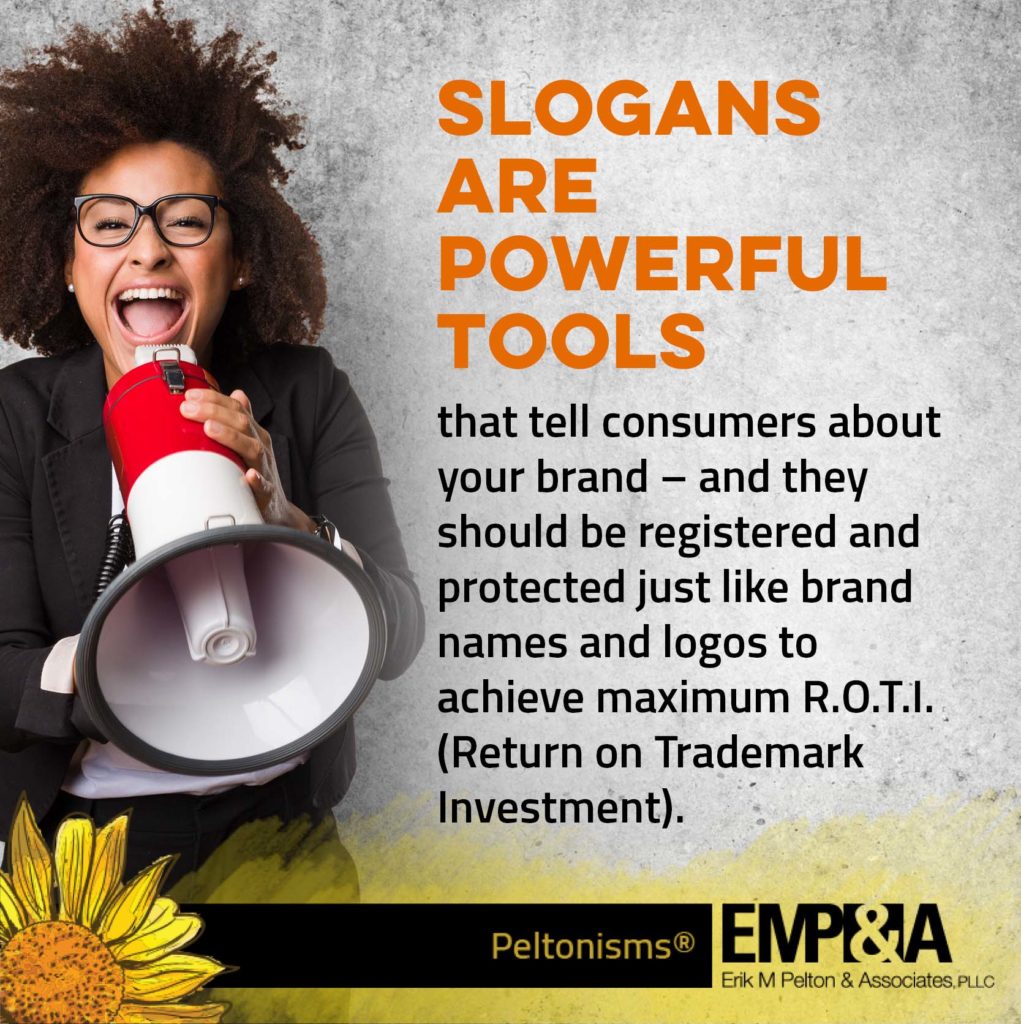
[IMAGE: Peltonism graphic]
Why Trademark Protection for a Slogan Matters
A successful slogan can become one of the most recognizable parts of your brand.
Businesses spend significant time and money developing taglines, incorporating them into websites and advertising, printing them on products and packaging, and building consumer recognition around them.
If your slogan becomes a valuable brand asset, federal trademark registration can provide important benefits and strengthen your ability to protect it.
Before investing heavily in a new slogan, it can also be valuable to conduct a comprehensive trademark search to identify potentially conflicting trademarks.
Frequently Asked Questions About Slogans and Trademarks
What is a slogan?
A slogan is a short phrase used by a business or organization to communicate a brand message, benefit, value, or identity. Slogans are often used in advertising and marketing alongside a business name or logo.
What is the difference between a slogan and a tagline?
The terms “slogan” and “tagline” are frequently used interchangeably. Both generally refer to memorable phrases associated with a business, product, service, or marketing campaign.
What makes a slogan catchy?
Catchy slogans are generally easy to remember and distinctive. Techniques such as rhyme, repetition, alliteration, humor, wordplay, emotional language, and short calls to action can make slogans more memorable.
Can I trademark a slogan or tagline?
Potentially, yes. A slogan may qualify for federal trademark registration when it functions as a trademark identifying the source of particular goods or services and satisfies the other requirements for registration.
Not every slogan is automatically eligible for trademark protection. Common, informational, descriptive, or merely ornamental phrases can present challenges.
Do I need a separate trademark application for my slogan and logo?
If a business wants separate federal registrations covering its business name, logo, and slogan independently, it will generally need to file separate trademark applications for those distinct marks.
A registration for a logo containing words protects the mark as shown in that registration; it is not necessarily equivalent to obtaining separate registrations for each individual branding element.
Can two businesses use the same slogan?
Sometimes.
Trademark rights are not simply about whether two phrases are identical. A key issue is whether consumers are likely to be confused about the source of the goods or services.
As a result, similar or even identical wording may sometimes coexist when the marks are used for sufficiently different goods or services and the circumstances do not create a likelihood of confusion. Other trademark considerations can also affect the analysis.
Should I search for trademarks before using a new slogan?
Yes. Before investing in a new slogan, businesses should investigate whether someone else has already established rights in the same or a confusingly similar mark.
A comprehensive trademark search can look beyond exact matches and help identify similar trademarks that could create registration problems or legal risks.
Protect a Great Slogan Before It Becomes a Problem
A great slogan can capture something special about a business in just a handful of words.
Once customers begin associating that phrase with your brand, it can become valuable intellectual property—just like your business name or logo.
If you are developing a new slogan or already use a tagline that has become an important part of your brand, consider whether federal trademark protection should be part of your trademark strategy.
Erik M. Pelton & Associates has helped businesses protect thousands of trademarks. Contact our experienced trademark attorneys to discuss protecting your brand name, logo, slogan, or other valuable brand assets.

